In This Guide
The saddle is one of humanity's oldest and most continuously refined technologies. Evidence of padded riding seats appears in Assyrian art from around 700 BC; the rigid tree saddle with stirrups — the technological leap that defines the modern saddle — emerged in Central Asia around the 4th century AD and spread westward to reshape both warfare and culture wherever it arrived. Today, more than 1,600 years after the stirruped saddle revolutionized mounted warfare, we ride in saddles that vary enormously by discipline but share the same fundamental engineering logic: distribute the rider's weight across the horse's back through a rigid or semi-rigid tree, provide a secure seat for the rider, and transmit communication between rider and horse with minimum interference.
What distinguishes one saddle type from another is the specific athletic context it serves. A dressage saddle and a barrel racing saddle are both saddles in the same fundamental sense — tree, seat, stirrups — but they represent opposite ends of the design spectrum because the movements they support are opposite in character. Understanding the design of any saddle requires understanding the sport it was built for.
English Saddles
English saddles evolved from European military and hunt traditions. They are defined by their lack of a horn, their close-contact design philosophy — less leather between rider and horse — and their reliance on the rider's balance rather than saddle structure for security. The English saddle tradition encompasses disciplines from the ultra-refined stillness of dressage to the explosive athleticism of show jumping, each demanding a different geometry from the saddle beneath the rider.
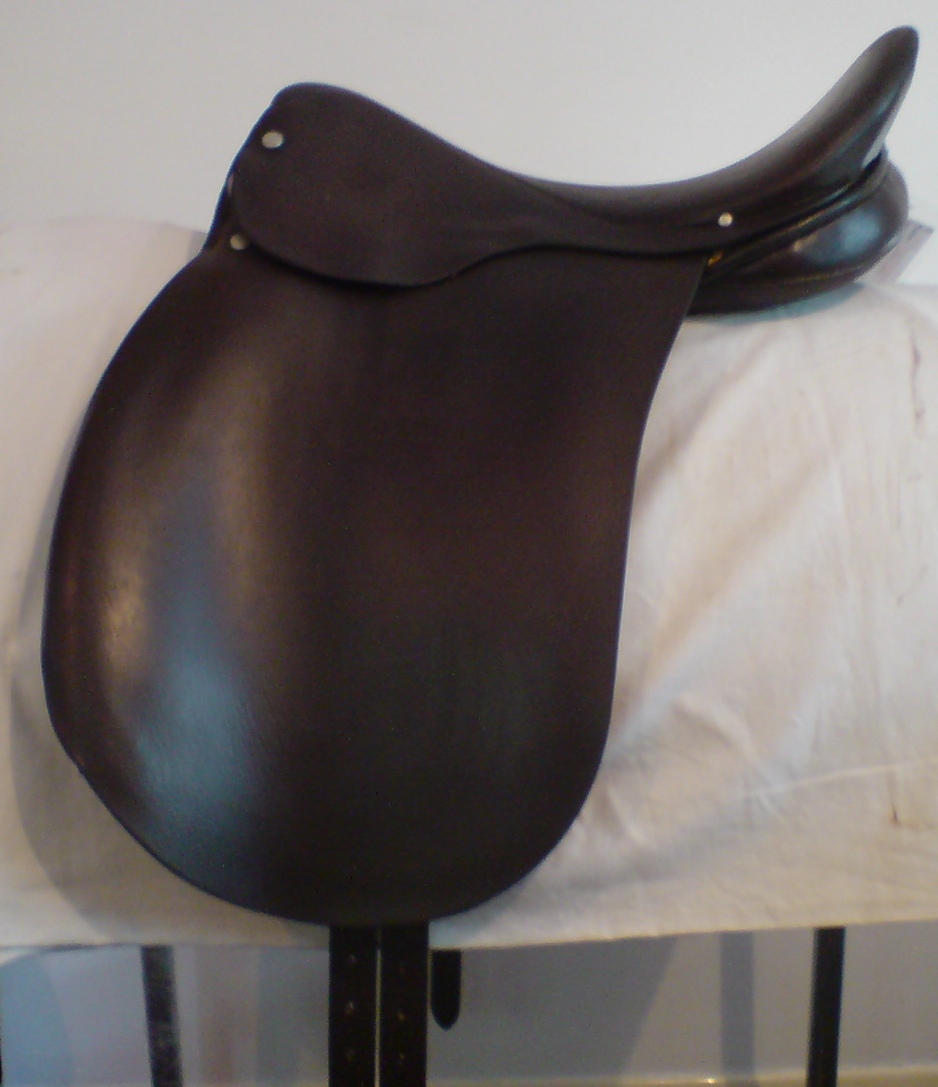 Photo: ThatPeskyCommoner / Wikimedia Commons, CC BY 3.0
Dressage Saddle
The dressage saddle is built for one purpose: to keep the rider's leg long and directly beneath the hip while allowing the deepest possible seat connection with the horse. Its defining features are a straight-cut flap — positioned directly below the rider with no forward angle — and a deep, centered seat that encourages the rider's weight downward into the saddle rather than forward over the knee. The dressage saddle has no horn, minimal pommel rise, and a moderately high cantle that supports the seat without confining it.
At the Olympic level, dressage demands movements of extraordinary refinement — piaffe (trot in place), passage (suspended trot), and pirouette (canter in a tiny circle) — and the saddle must allow the rider to communicate these movements through the seat and leg without any interference from the tack. Dressage saddle flaps are cut straight because the rider's leg is long and relatively static; the leg does not swing forward as it does in jumping.
Jumping / Close Contact Saddle
The jumping saddle is the most forward-cut English saddle, designed to accommodate the two-point position — the rider's weight distributed over the knee and lower leg with the seat lifted from the saddle — that is the correct position over a jump. The forward-cut flap allows the rider's knee to bend sharply upward as the horse's front end rises over a fence without the rider's knee pressing against the back of the flap and disrupting balance.
The close contact saddle — often used interchangeably with jumping saddle — is a slightly more conservative version of the forward-cut design, with less pronounced knee rolls and a slightly less extreme flap angle. Both designs share the shallow seat that allows the rider to lift clear of the saddle over a fence. A deep seat in a jumping saddle would work against the rider's ability to follow the horse's bascule — the arcing motion over the fence — cleanly.
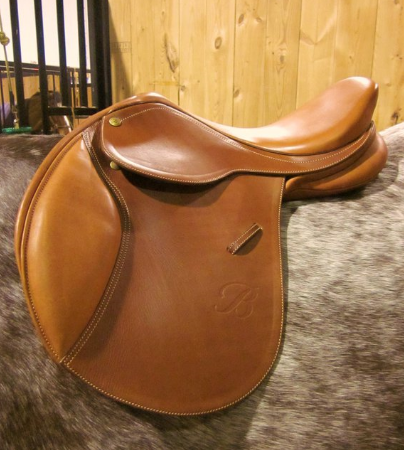 Photo: Danielle M. / Wikimedia Commons, CC BY 3.0
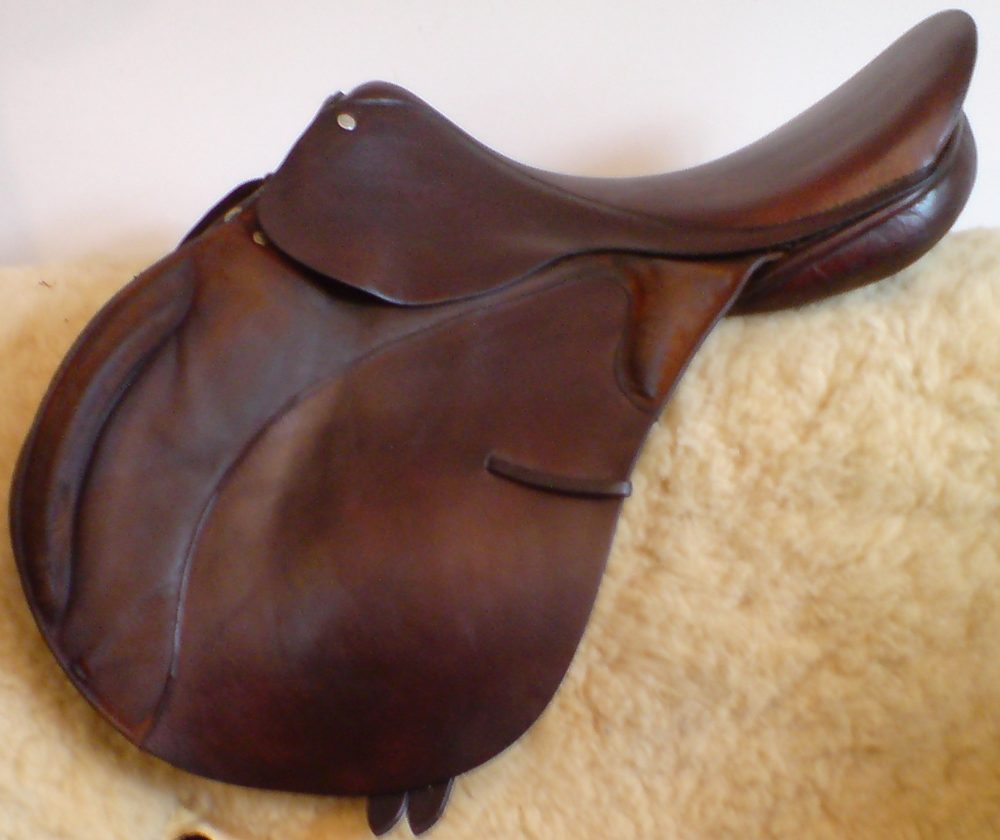 Photo: ThatPeskyCommoner / Wikimedia Commons, CC BY 3.0
Eventing Saddle
Eventing — sometimes called the triathlon of equestrian sport — requires horse and rider to compete in dressage, cross-country jumping, and stadium jumping across three consecutive days. The eventing saddle is the most versatile English saddle: cut forward enough to accommodate the two-point position over cross-country obstacles and stadium fences, but not so extreme that it prevents the long-leg dressage position the first day requires.
The cross-country phase places unique demands on the saddle that neither a pure dressage nor a pure jumping saddle can meet. Cross-country obstacles are jumped at speed, often on uneven terrain, at angles that stadium jumping never presents. The rider needs security through unexpected moments — a horse that spooks, a fence that rides differently than expected — without the saddle interfering with an independent, following seat. Cross-country suede or sticky-leather seat surfaces are common in eventing saddles for exactly this reason.
Hunt Seat / All-Purpose Saddle
The hunt seat saddle — also sold as the all-purpose English saddle — is the most widely-ridden English saddle style in the world. It occupies the design middle ground between dressage and jumping: more forward-cut than a dressage saddle, less extreme than a dedicated jumping saddle. For the rider who does not compete in a single specialized discipline — or for the student learning to ride — the all-purpose saddle accommodates flatwork, low jumping, trail riding, and general schooling without requiring a discipline-specific design.
The hunt seat tradition in American showing places emphasis on the rider's equitation — the quality of their position and communication — as much as the horse's performance. Hunt seat equitation classes at major shows evaluate riders over fences on a standard course, judging the position of the rider's leg, hand, and body through each fence. The saddle must allow the rider's position to express itself correctly without helping or hindering unduly.
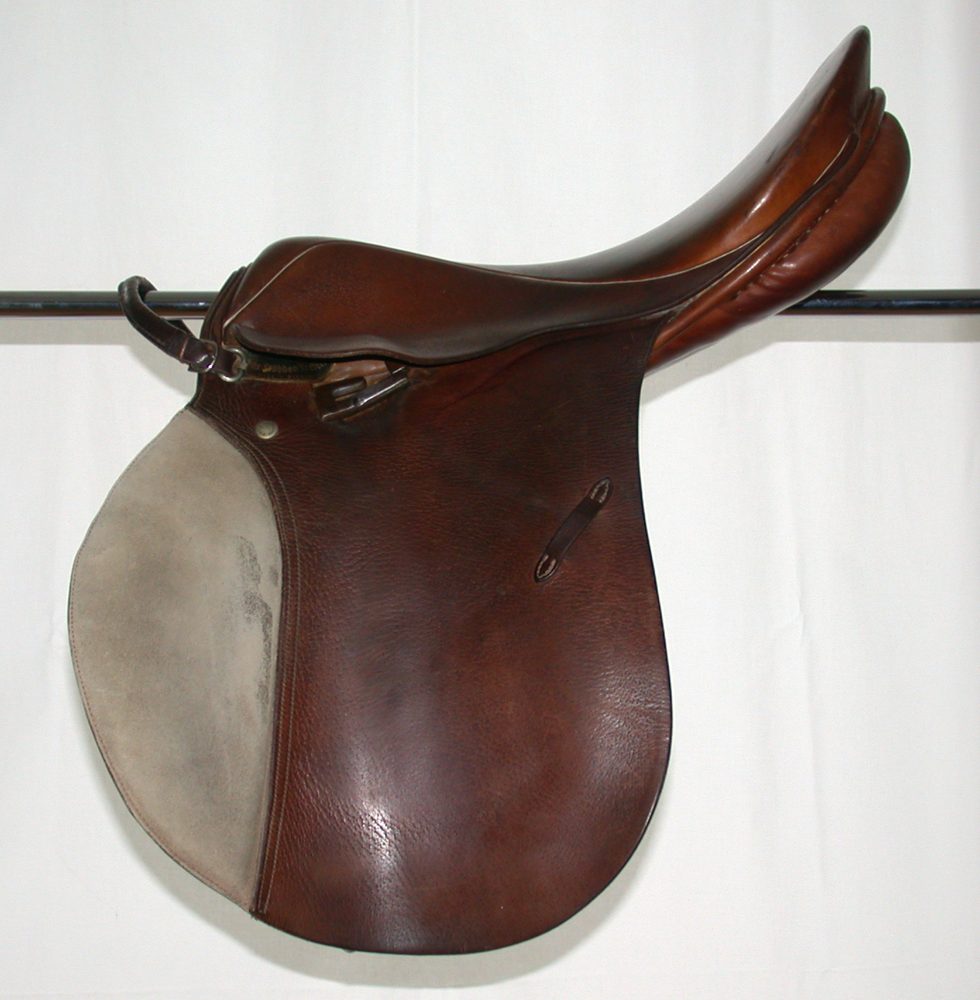
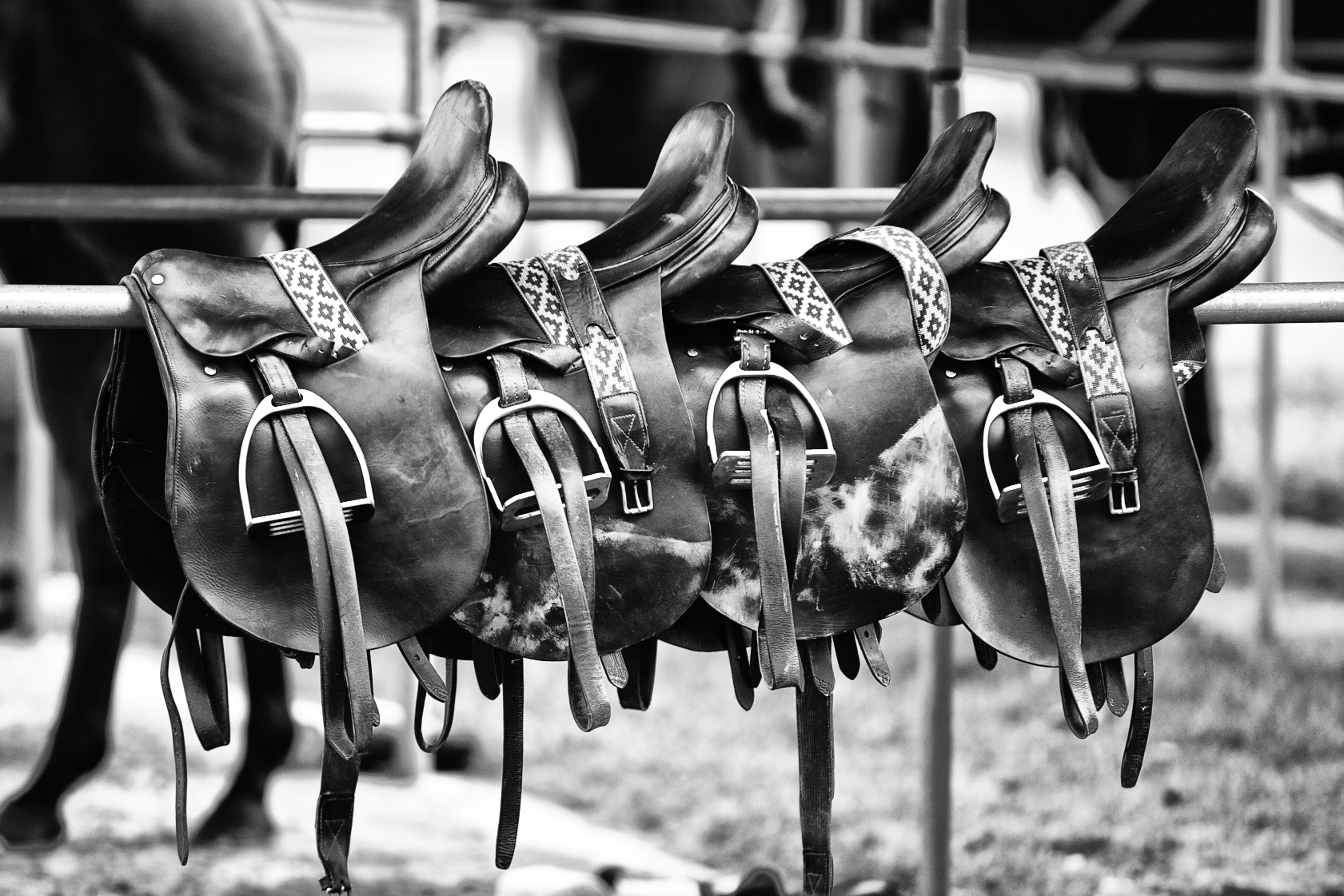 Photo: THOR / Wikimedia Commons, CC BY 2.0
Polo Saddle
The polo saddle is the flattest, most open English saddle in regular competition use. It has no knee rolls, a minimal pommel, and a nearly flat seat that allows the rider to shift weight dramatically in all directions while swinging a mallet with a full-body rotation at full gallop. A polo player reaches down and across their horse to strike a ball traveling at speed while simultaneously steering a horse that may be galloping at 35 miles per hour through a field of other horses. The saddle must stay completely out of the way of that movement.
The polo saddle's open design is a deliberate trade-off: it provides almost no passive security — no knee rolls to catch the rider, no deep seat to contain the position — in exchange for total freedom of movement. Polo players develop enormous leg strength and balance because the saddle provides none of the structural assistance that other English designs offer.
Racing / Flat Saddle
The racing flat saddle is the most minimal saddle in existence — a thin leather pad over a minimal tree, weighing as little as 400 grams (under one pound) in elite Thoroughbred flat racing. Its design is stripped of every feature that is not strictly necessary to hold the jockey's stirrups and provide minimal contact with the horse's back. There is no cantle. The pommel is vestigial. The seat surface is minimal. The entire saddle exists only to anchor the stirrups that the jockey rides in the two-point position throughout the race.
The jockey's weight is carried almost entirely through the stirrups and the inner knee, not through the seat. This allows the jockey to crouch low over the horse's withers — reducing wind resistance and keeping their weight forward over the horse's center of balance at full gallop. The saddle barely contacts the horse's back in this position. Racing saddles are required to meet minimum weight specifications set by racing authorities; handicapped races prescribe total weight (jockey plus saddle) to equalize competitive conditions.
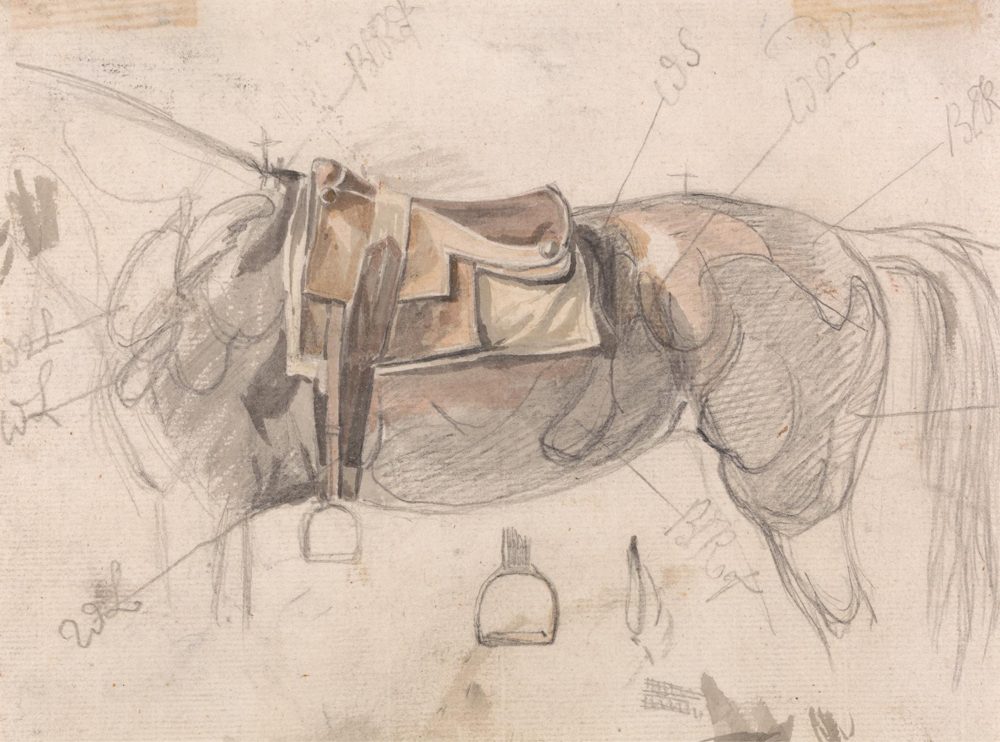 Sawrey Gilpin study / Yale Center for British Art, public domain
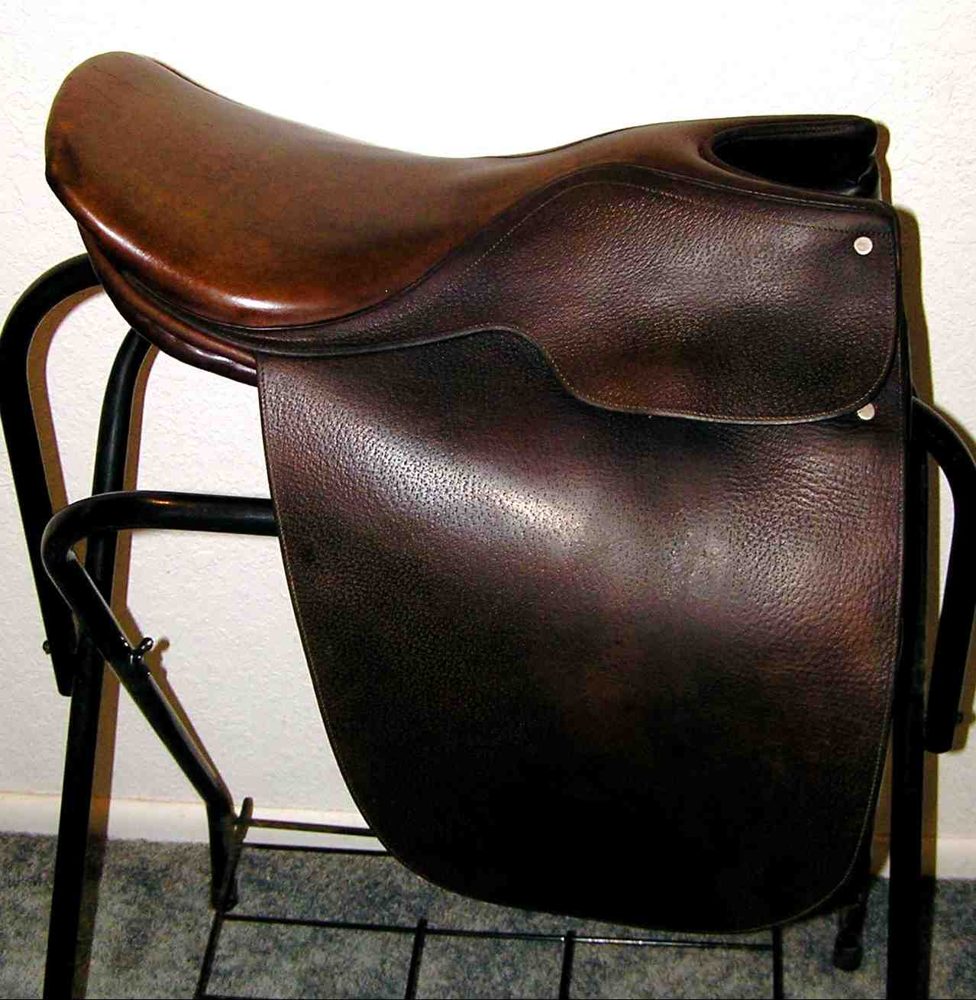 Photo: Wikimedia Commons, CC BY-SA 3.0
Saddle Seat Saddle
The saddle seat saddle is the most visually distinctive English saddle — a flat, wide design with a cut-back pommel that sits far back on the horse's back, behind the shoulders, to allow the horse's front end to move as freely and expressively as possible. It is used with gaited breeds — the American Saddlebred, the Tennessee Walking Horse, the Missouri Fox Trotter — whose high-stepping, animated gaits are showcased in show ring competition.
The saddle seat position is unique: the rider sits more toward the back of the saddle than in any other English discipline, with a nearly level stirrup position (neither long like dressage nor short like jumping) and an upright, show-ring posture. The cut-back pommel ensures the saddle does not contact the horse's withers as the front legs are elevated dramatically in the park trot and slow gait.
Western Saddles
The western saddle tradition descends from Spanish colonial horsemanship and was shaped by the specific demands of cattle ranching on the American frontier. Where English saddles evolved toward minimum leather and maximum close contact, the western tradition retained the saddle horn — essential for rope work — and built designs that distributed weight across a horse's back for long working days rather than optimizing for the short, intense athletic demands of arena competition. The specialization era that followed the founding of the NRHA, NCHA, and NRCHA in 1949 fragmented the western tradition into a family of highly specialized competition designs, each one an engineering response to a specific judged discipline.
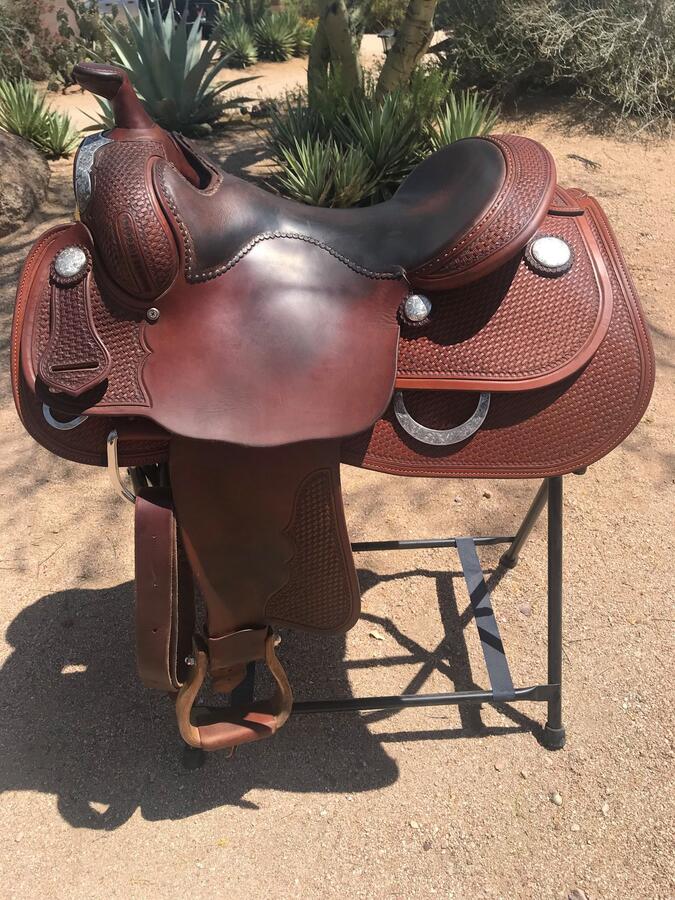 Andreas Maschke reiner — CertifiedUsedSaddles.com
Reining Saddle
The reining saddle is the most refined western competition saddle — a slick-fork, flat-seat design engineered to keep the rider quiet and out of the horse's way while the horse executes sliding stops, 360-degree spins, lead changes, and speed-controlled circles. The absence of swells (the horn-flanking bulges of a traditional stock saddle) is the reining saddle's most distinctive visual feature, and it serves a precise function: swells restrict lateral leg movement that spin work requires and interfere with the close-contact thigh communication that reining patterns demand.
Leading reining saddle makers include Bob's Custom Saddle (Bob Avila and other signature models), Superior Saddlery (signature models by Craig Schmersal, Casey Deary, Jason Vanlandingham, Shawn Flarida, and others), Donn Leson (Reinmaker, TVB models), and Kyle Tack. Superior's SYMMETREES™ precision tree manufacturing has set a new standard for tree consistency that outside-sourced trees cannot match.
Cutting Saddle
The cutting saddle is the most specialized western saddle — engineered entirely around the NCHA rule that prohibits a rider from using the reins once the horse commits to a cow. The saddle must hold the rider through violent, unpredictable lateral movements with no rein contact available. Its deep seat, tall horn, high dished cantle, and swell fork are not stylistic choices; they are structural responses to the specific athletic demands of working cattle without hands.
The cutting horse is perhaps the most athletically explosive animal in western competition. Its lateral direction changes can occur in under a stride; its drop stops require the rider's body to absorb forces that arrive without warning. The saddle that holds the rider through all of this while still allowing the hip mobility needed to follow the horse's action represents one of the most demanding design briefs in western tack history. Teddy Johnson and Calvin Allen built the benchmarks; Superior Saddlery's Ranch Cutter model brings precision manufacturing to the category.
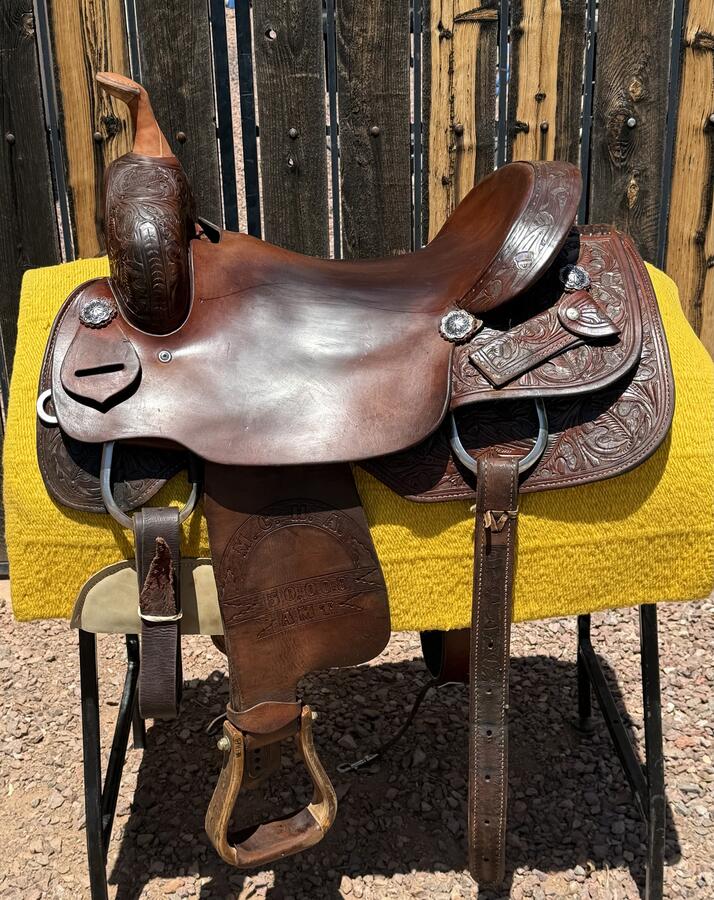 Teddy Johnson cutter — CertifiedUsedSaddles.com
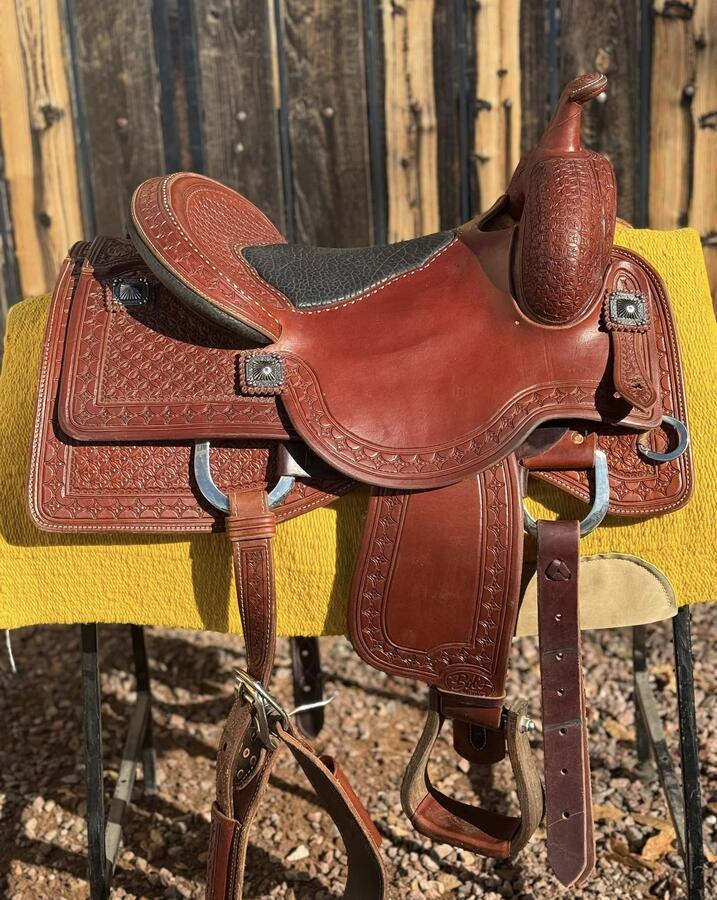 Bob’s Custom Lady Cowhorse — CertifiedUsedSaddles.com
Reined Cow Horse Saddle
The reined cow horse saddle is the most demanding brief in western tack: a single design that must perform through a reining pattern, fence work, boxing, and open cow work without failing any of them. The cow horse saddle borrows the close-contact seat philosophy of the reining saddle and combines it with enough cantle support for fence stops and enough rigging substance (always double) for the forces of cattle work — at intermediate values in both cases. It cannot fully optimize for any single phase because it must function across all of them on the same day.
Bob's Custom Saddle's Lady Cowhorse is the category benchmark — purpose-built for NRCHA demands, immediately recognizable in competition, and consistently sought-after in the certified used market. Superior Saddlery's JK Cowhorse/Reiner represents the precision manufacturing approach applied to the multi-phase demands of the discipline.
Ranch Saddle
The ranch saddle is the oldest western saddle design still ridden in active competition — the ancestor from which the reining, cutting, and cow horse saddles all descended. Where those specialized builds shed features in exchange for performance, the ranch saddle retained them: the stout roping horn, the double rigging, the longer heavier skirts, the traditional tooling that identifies it as working ranch tack. It is the only western competition saddle that is also a genuine working tool.
AQHA Ranch Riding competition explicitly requires a working-ranch appearance, which means a reining or cow horse saddle cannot be used without risking negative attention from judges on appearance grounds alone. Superior Saddlery's ranch line covers the spectrum from the functional BA Ranch Riding to the full-silver Nevada Border show model. In the certified used market, the SRS Ranch Saddle at $1,495 and the Rios Bros. Roper at $495 represent the accessible end of a range that extends to $5,495 for a Superior Ranch Rider Deluxe.
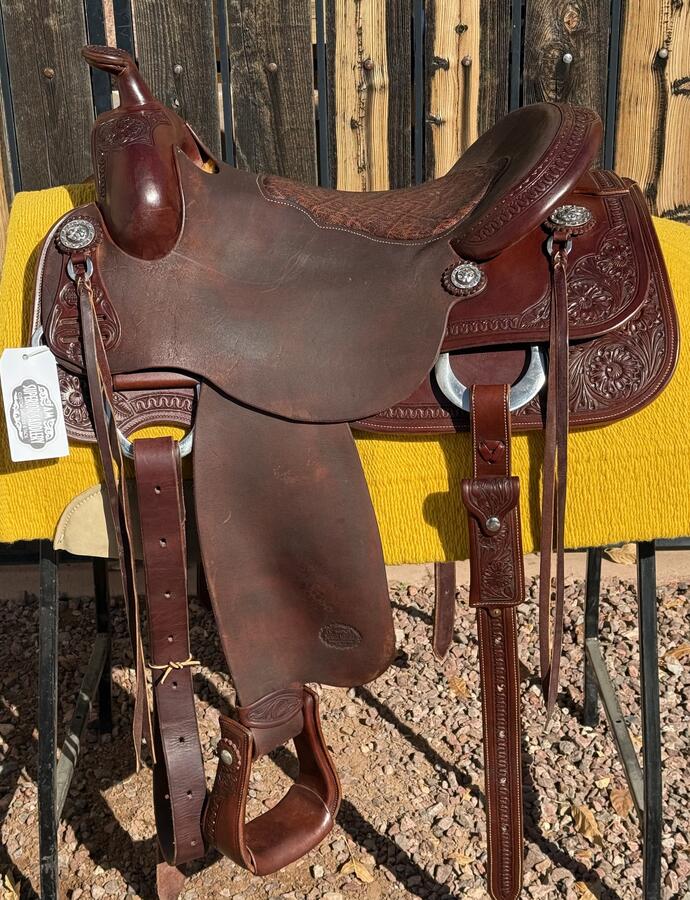 Superior Ranch Rider Deluxe — CertifiedUsedSaddles.com
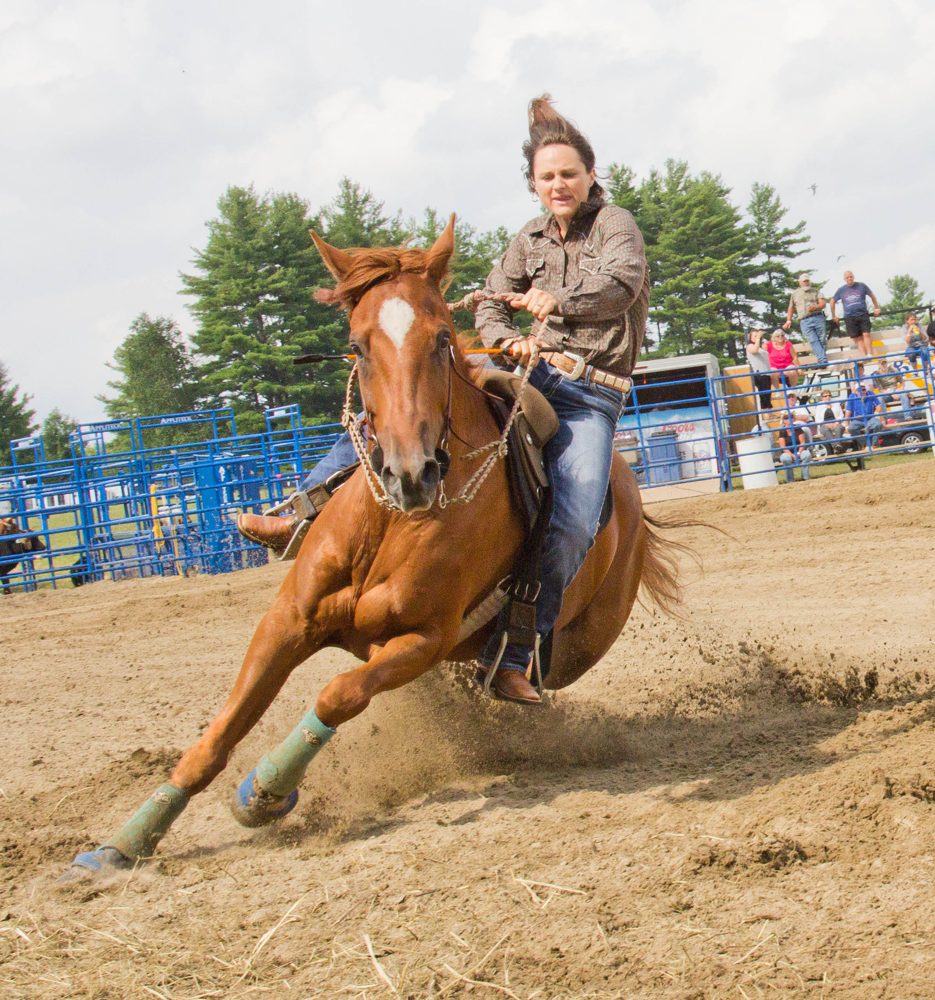 Photo: Wikimedia Commons, CC BY 2.0
Barrel Racing Saddle
The barrel racing saddle must solve a specific problem: keep the rider secure through the violent lateral lean of a barrel turn at full speed while being light enough not to slow a horse competing against a clock measured in hundredths of a second. A barrel horse running the cloverleaf pattern decelerates hard before each barrel, drops into a lateral lean through the turn, then accelerates hard to the next barrel — three times per run, completed in under 16 seconds at the elite level.
Barrel saddles typically feature a high, reinforced horn that the rider can brace against through the turn — not for dallying, but for physical stability. The seat is deeper than a reining saddle and the cantle higher, providing the security that the lateral lean demands. Weight reduction drives material selection: lightweight leather, aluminum hardware where steel would otherwise be used, and a tree built for minimum mass consistent with structural integrity.
Roping Saddle
The roping saddle is the heaviest and most structurally robust western competition saddle. It is designed to absorb the shock forces generated when a horse stops hard at the end of a rope attached to a running calf or steer — forces that can exceed several hundred pounds in a fraction of a second. The horn is the largest, most heavily wrapped of any western saddle type; the dally wrap must hold the rope without slipping under dynamic load, and the horn-to-tree connection must transmit those loads into the tree without failure.
Team roping divides these demands between two riders — the header (who catches the horns) and the heeler (who catches the hind legs) — and specialized saddle designs exist for each role. Header saddles tend toward moderate weight with a horn built for the fast dally that catching horns requires; heeler saddles are built for the sustained loading of holding a steer while the barrier closes. Both must be heavier than other western competition saddles because the loads are simply heavier.
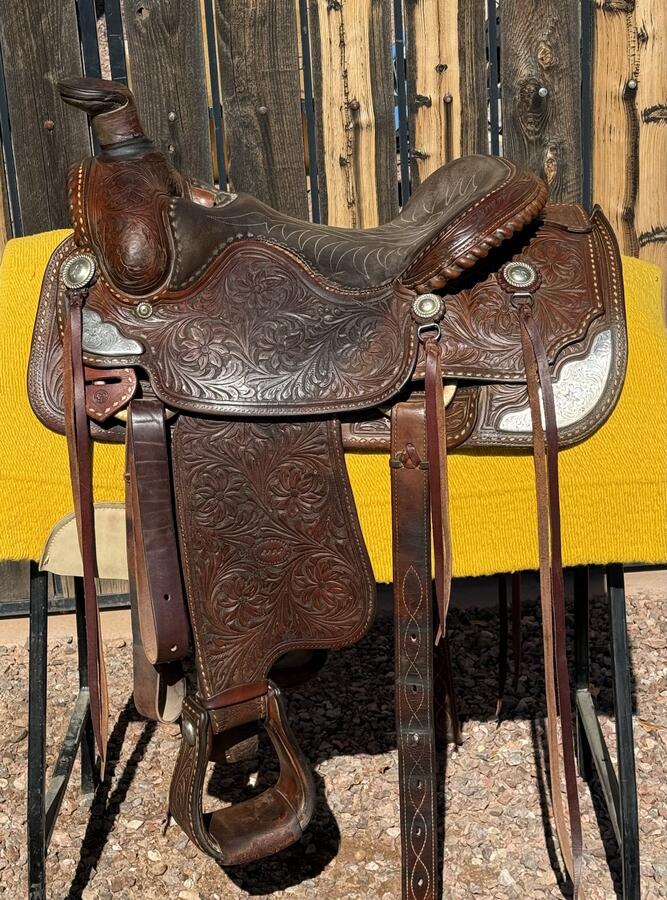 Rios Bros. roper — CertifiedUsedSaddles.com
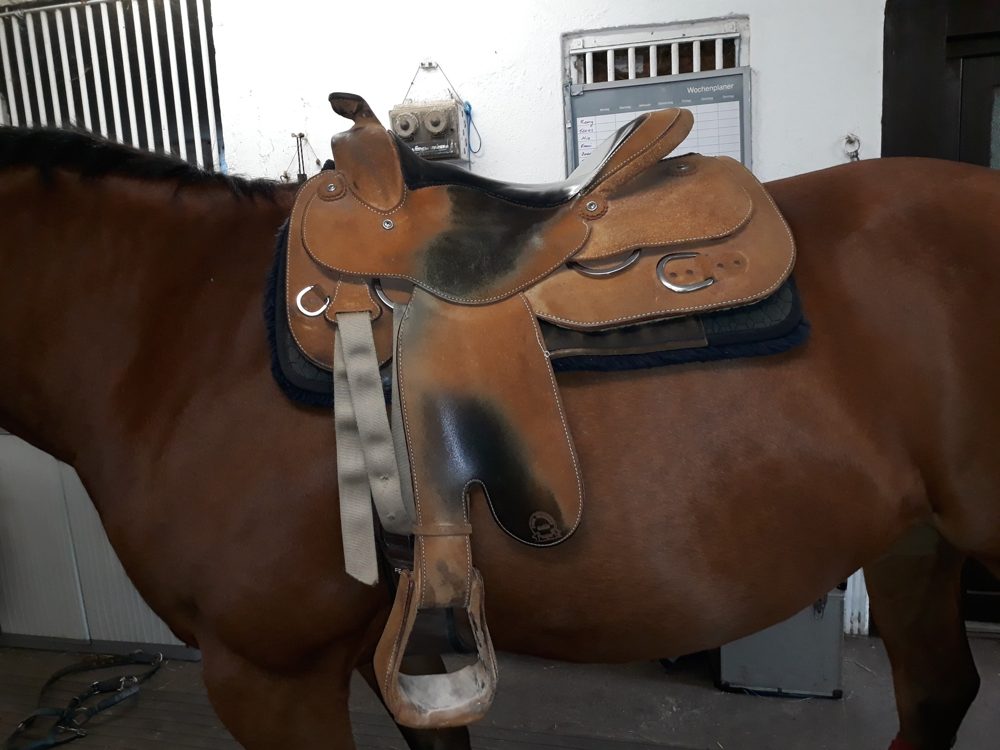 Photo: Wikimedia Commons, CC BY-SA 4.0
Trail / Western Pleasure Saddle
The trail saddle and western pleasure saddle prioritize long-duration comfort over the athletic demands of competition performance. Trail saddles are designed for hours in the saddle across varying terrain — they typically feature a moderately deep seat for security on uneven ground, medium cantle height, and construction choices that favor weight distribution across the horse's back over minimal mass. Saddlebag attachment points, horn tie rings, and comfortable fender swing are all considerations that competition saddles can ignore.
Western pleasure show saddles — used in AQHA Western Pleasure classes — add the silver and tooling that show ring appearance demands to a functional western geometry. Western Pleasure horses perform at walk, jog, and lope with an emphasis on smooth, slow, easy movement; the saddle must present a polished show appearance while allowing the rider to sit quietly through the extended jog and lope that the class requires.
Endurance, Australian, and Specialty Saddles
Beyond the English and western traditions lies a third category of saddle designs that serve specific athletic demands, cultural traditions, or working contexts that neither mainstream tradition fully addresses. The endurance saddle solves the problem of covering 50 to 100 miles in a single day. The Australian stock saddle solves the problem of working cattle in terrain that both English and western traditions evolved without encountering. The sidesaddle solves a historical problem — riding in skirts — and remains in active competition. Each of these designs is a complete engineering response to a real set of demands.
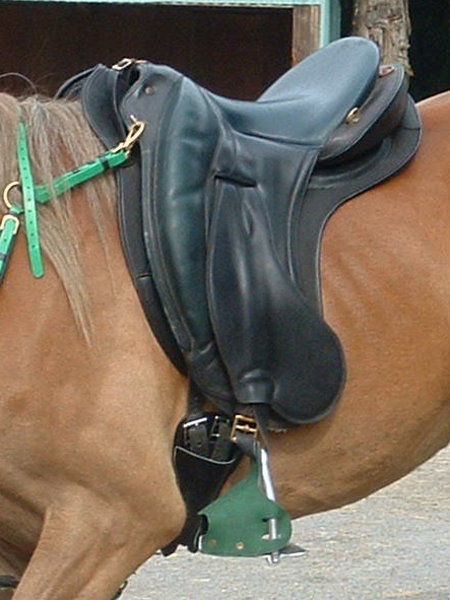 Photo: Eponimm / Wikimedia Commons, CC BY-SA 3.0
Endurance Saddle
The endurance saddle is the most weight-conscious saddle design in active competition use — heavier than a racing flat saddle but lighter than any other discipline-specific design, because every gram of saddle weight is carried by the horse for up to 24 consecutive hours in a 100-mile event. The Tevis Cup — the most prestigious 100-mile endurance race in the world, run in the Sierra Nevada mountains — requires horses and riders to navigate 100 miles of mountain terrain including river crossings, technical single-track, and significant elevation change within 24 hours.
Endurance saddles are often built on synthetic trees rather than wood to reduce weight. The seat is typically padded for rider comfort across many hours of continuous riding. Multiple rigging attachment points allow the rider to adjust cinch position as the horse's back shape changes through sweating and muscle fatigue over a long ride. Bar design prioritizes even weight distribution across the horse's back because a pressure point that is insignificant over an hour becomes a serious welfare issue over twelve.
Australian Stock Saddle
The Australian stock saddle represents an independent evolution of the stock saddle concept that reached different conclusions than either the English or American traditions — a design shaped by the specific demands of mustering cattle in the Australian outback, where terrain is rougher, distances are greater, and the absence of cattle drives ending at a railroad meant that roping techniques developed differently than in the American West.
The most immediately distinctive feature of the Australian saddle is its poleys — the knee rolls on both sides of the front panel that lock the rider's thighs in position. These poleys provide the lateral security that the American western saddle achieves through its horn and deep seat, through a completely different mechanism: the rider's leg is held in position by the poley rather than the body by the seat. The result is a saddle that is significantly more secure than an English saddle without requiring the rider to grip, and that allows the extended, somewhat longer-stirrup position that suits the long hours of Australian stock work.
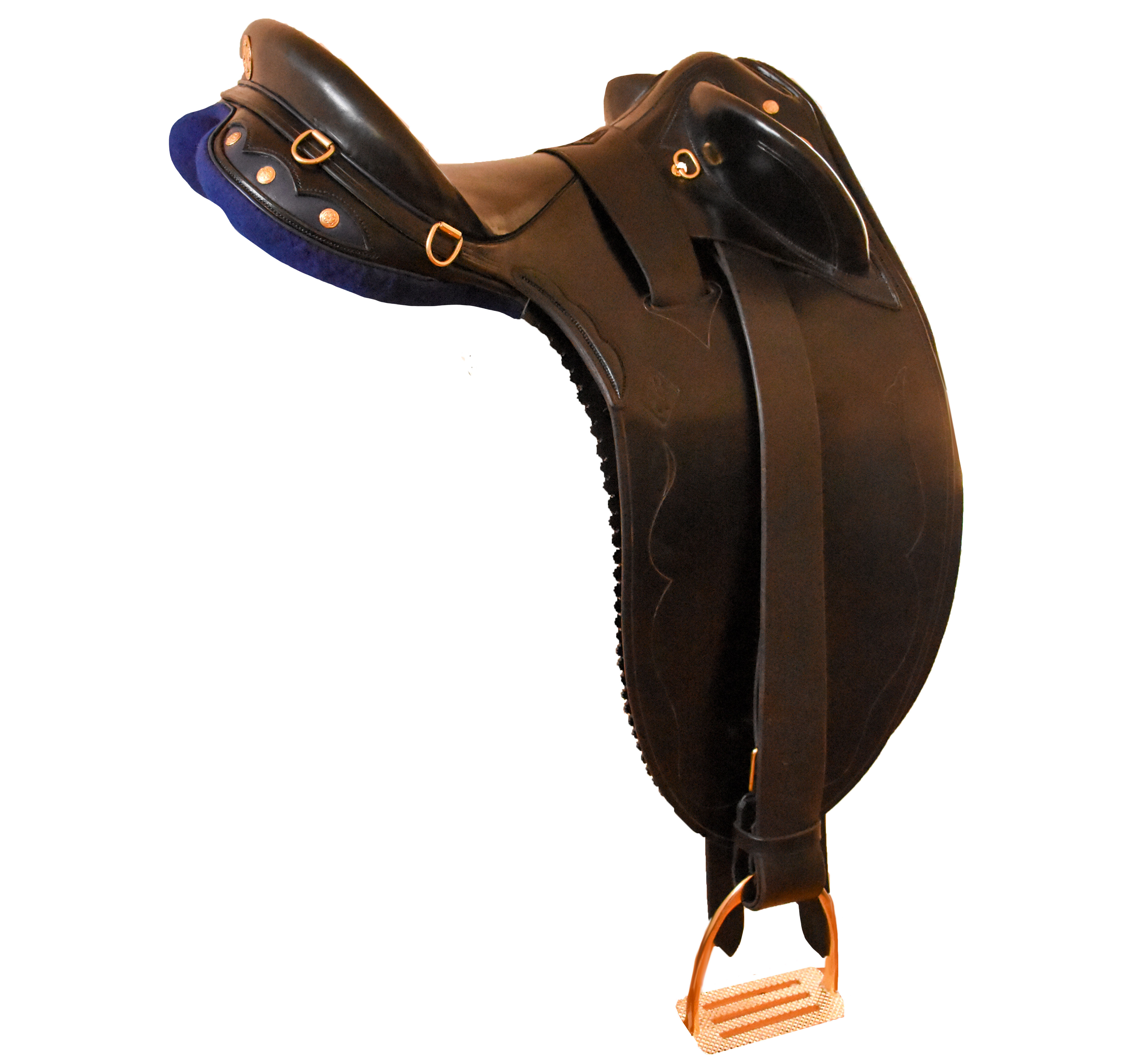 Photo: Neicyqld / Wikimedia Commons, CC BY-SA 4.0
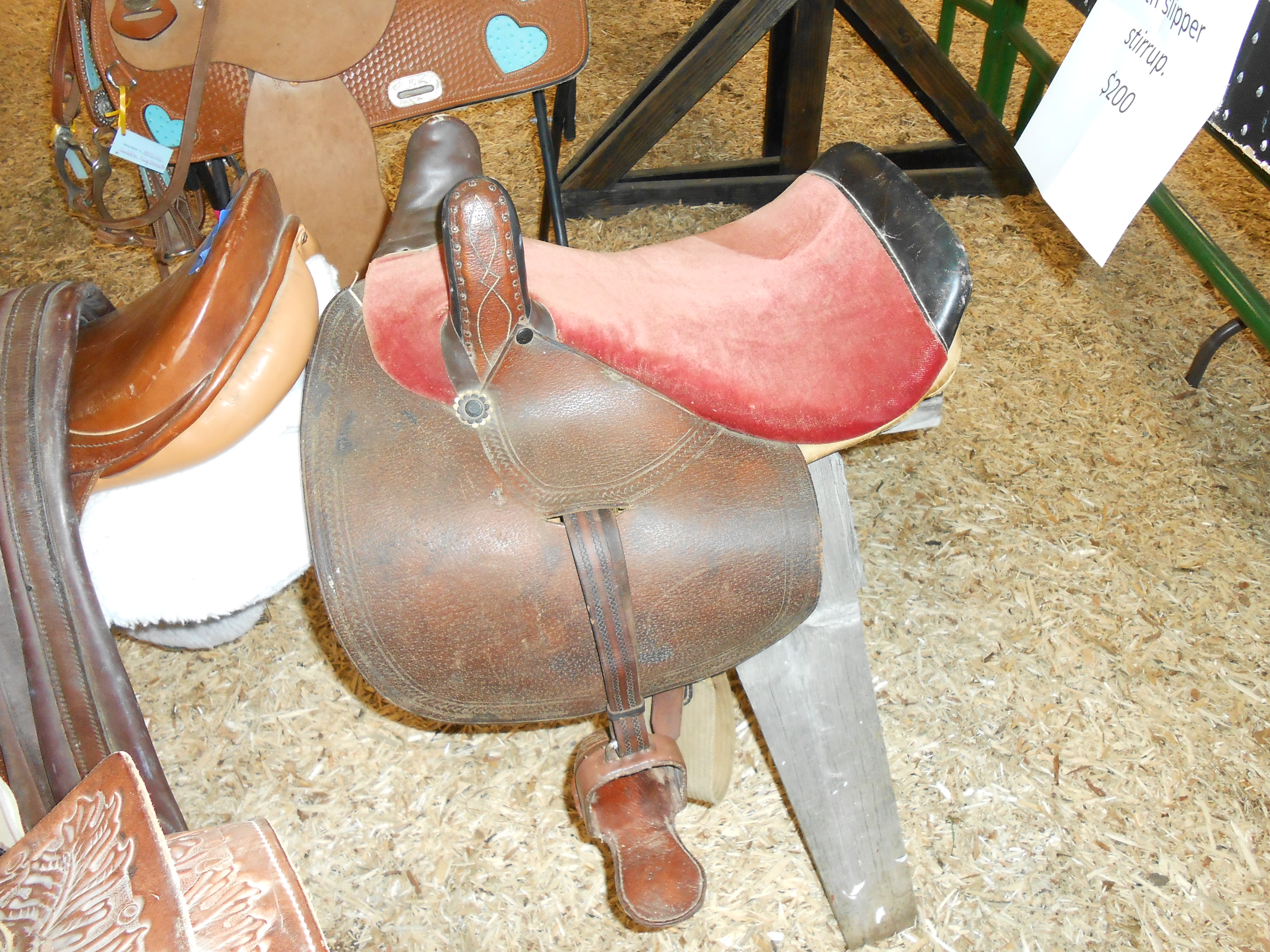 Photo: Montanabw / Wikimedia Commons, CC BY-SA 3.0
Sidesaddle
The sidesaddle is the oldest purpose-specific saddle design still ridden in active competition, with origins in 14th-century Europe where women of noble birth rode with both legs draped over one side of the horse. The modern sidesaddle — developed in its current form in the 19th century with the addition of the leaping horn that revolutionized sidesaddle security — positions both of the rider's legs to the left side of the horse, the right knee hooked over the upper pommel (fixed head) and the left foot in a single stirrup.
The leaping horn — the curved projection that the right knee hooks under during jumping — is the critical innovation that made sidesaddle jumping possible and safe. Before its introduction, sidesaddle riders could not jump with any security because there was no mechanical connection between the rider's right leg and the saddle. The leaping horn provides this connection: the rider's right knee clamps under it during a fence, providing the bracing that makes jumping in a sidesaddle athletically viable.
Treeless Saddle
The treeless saddle removes the fundamental structural element that defines all traditional saddle design — the rigid or semi-rigid tree — and replaces it with a flexible padded panel that conforms to the horse's back shape dynamically rather than fitting to a fixed tree geometry. The appeal is direct: horses with unusual back shapes that no standard tree fits correctly can theoretically be ridden in a treeless saddle that accommodates their individual topline without pressure points.
The debate around treeless saddles is genuine and ongoing in the equestrian veterinary community. Proponents argue that a correctly-fitted treeless saddle distributes weight more evenly by conforming to the horse's back rather than bridging irregularities. Critics argue that without a rigid tree, the rider's weight concentration on a small padded area creates higher peak pressure than a correctly-fitted tree distributes across a larger surface. The practical consensus among saddle fitters is that a correctly-fitted traditional tree is superior to a treeless design for most horses, but that treeless designs serve specific horses with conformational challenges that conventional trees cannot address.
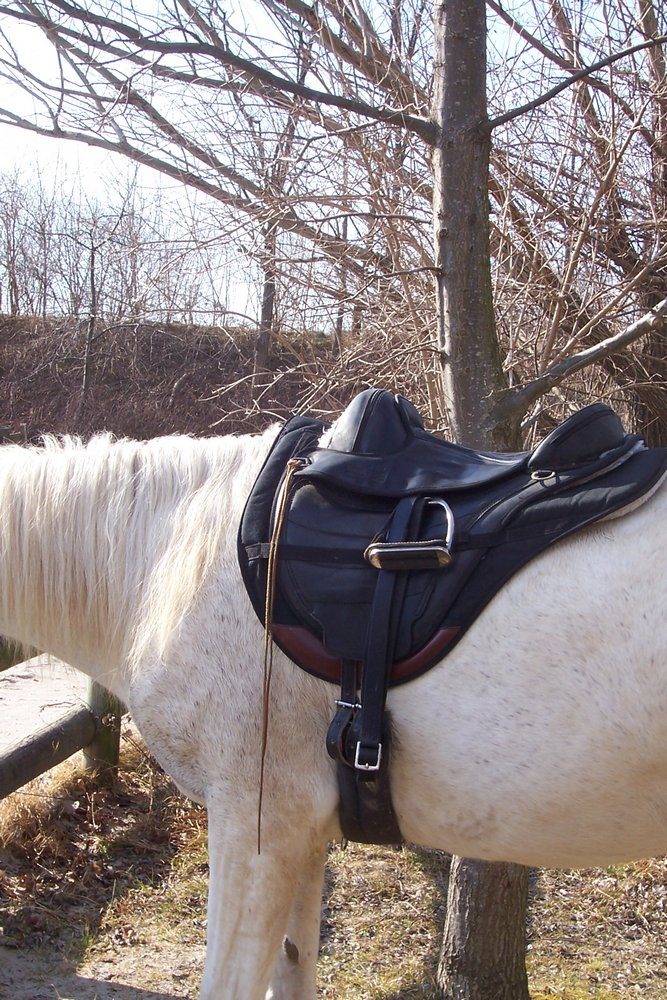 Photo: Wikimedia Commons, CC BY-SA 4.0
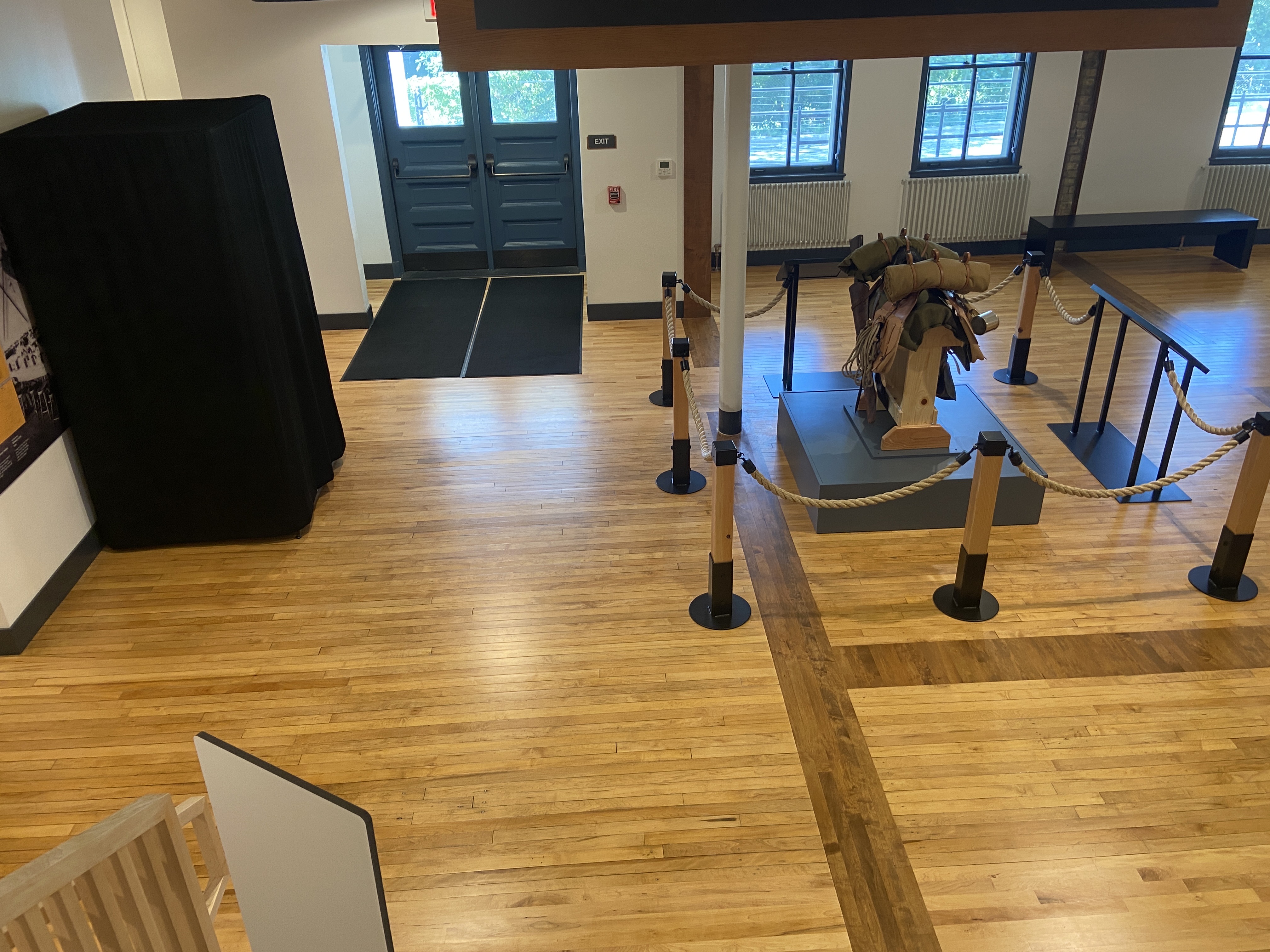 Photo: Myotus / Wikimedia Commons, CC BY-SA 4.0
McClellan Military Saddle
The McClellan saddle was designed by George B. McClellan in 1855 following his study of Prussian, Hungarian, and Cossack military saddle designs, and was adopted as the standard U.S. Army cavalry saddle in 1859. It remained the official U.S. cavalry saddle until the last horse cavalry units were mechanized in 1943 — an 84-year production run that made it the most widely used military saddle in American history.
The McClellan's design was driven by two military requirements: weight and durability. It had to be light enough that a horse could carry it across the distances that cavalry operations demanded without fatigue, and it had to be simple enough to be mass-produced to consistent specifications and repaired in the field without specialized tools. The distinctive open channel running fore to aft through the center of the saddle — which gives the McClellan its immediately recognizable silhouette — serves both purposes: it reduces weight while also keeping the rider's weight off the horse's spine.
Pack Saddle
The pack saddle is the only saddle in common use that is not designed for a rider. It exists to distribute the weight of cargo — supplies, equipment, game from a hunt, or material for backcountry expeditions — across a pack horse or mule's back with the same engineering logic that a riding saddle distributes a rider's weight. The two most common pack saddle designs are the Decker and the sawbuck.
The sawbuck pack saddle — named for the X-shaped wooden crossbucks at both front and rear — is the older and simpler design, built for securing loads with lash ropes in the traditional diamond hitch configuration. The Decker pack saddle, developed in Idaho in the early 20th century, uses a rounded metal ring in place of the wooden crossbucks, which distributes load more evenly and allows panniers (pack bags) to swing freely rather than riding rigidly against the horse's side. Modern backcountry outfitters predominantly use Decker systems for their load-distribution advantages.
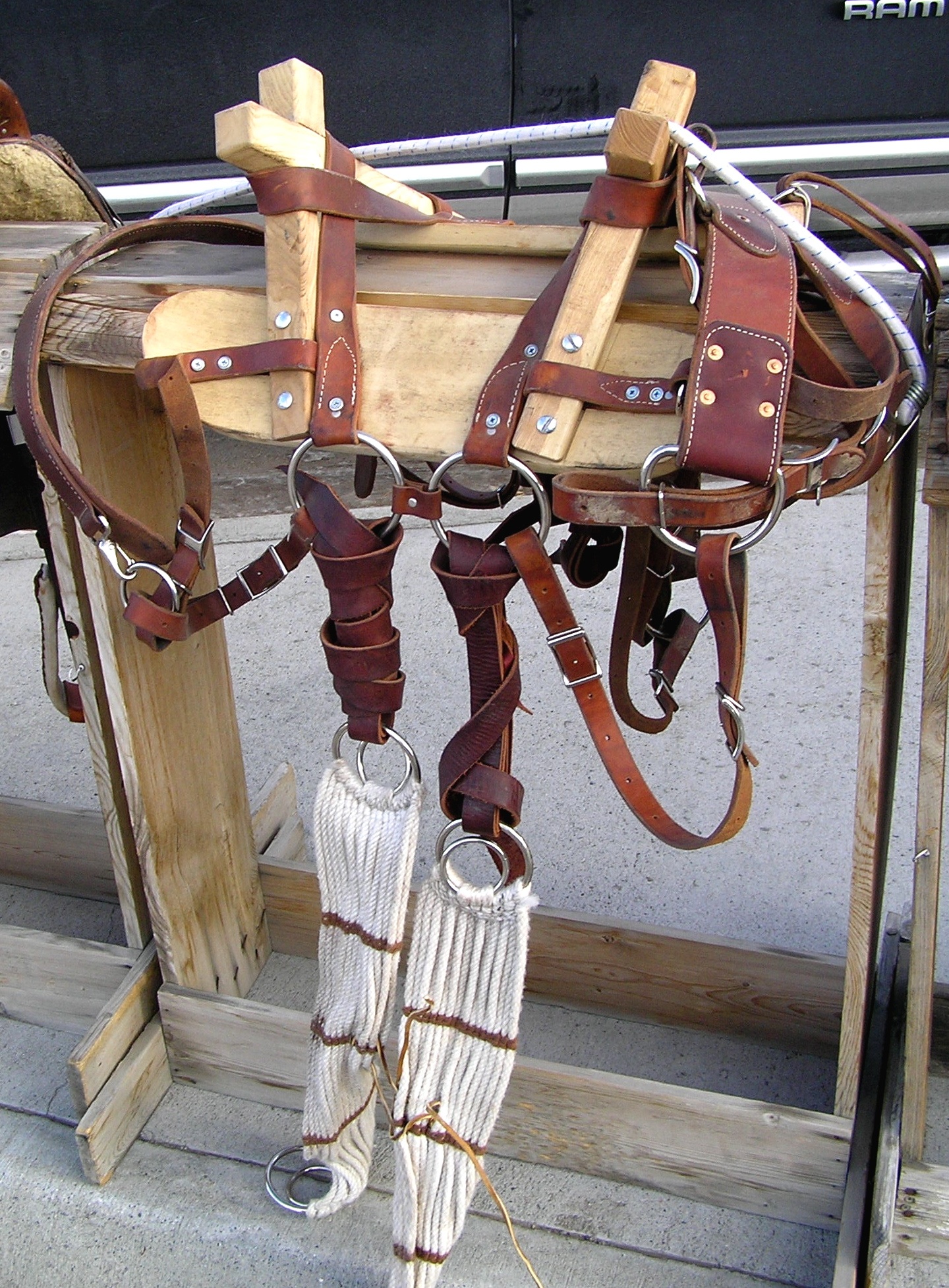 Photo: Montanabw / Wikimedia Commons, CC BY-SA 3.0
Shop the Western Saddle Network
WesternSaddles.ai carries new Superior Saddlery saddles and certified used western performance saddles through our official sponsors — David Solum's inspected inventory and Andreas Maschke's SYMMETREES™ precision builds.
Further Reading
Complete History of the Western Saddle · Reining Saddle Guide · Cutting Saddle Guide · Cow Horse Saddle Guide · Parts of a Western Saddle · How to Buy a Certified Used Saddle · Reining vs. Cutting vs. Cow Horse Compared